
Where water runs
Canal Bank & Swale Erosion Control in Miami, FL
Keeping soil in place on the banks, swales and ditches that carry South Florida's summer rain.
- No-charge site visit and a written quote before any work
- Seed, soil prep and storm protection on one itemized quote
- Grass choice explained for your sun, shade and irrigation
Holding Soil Where Water Concentrates
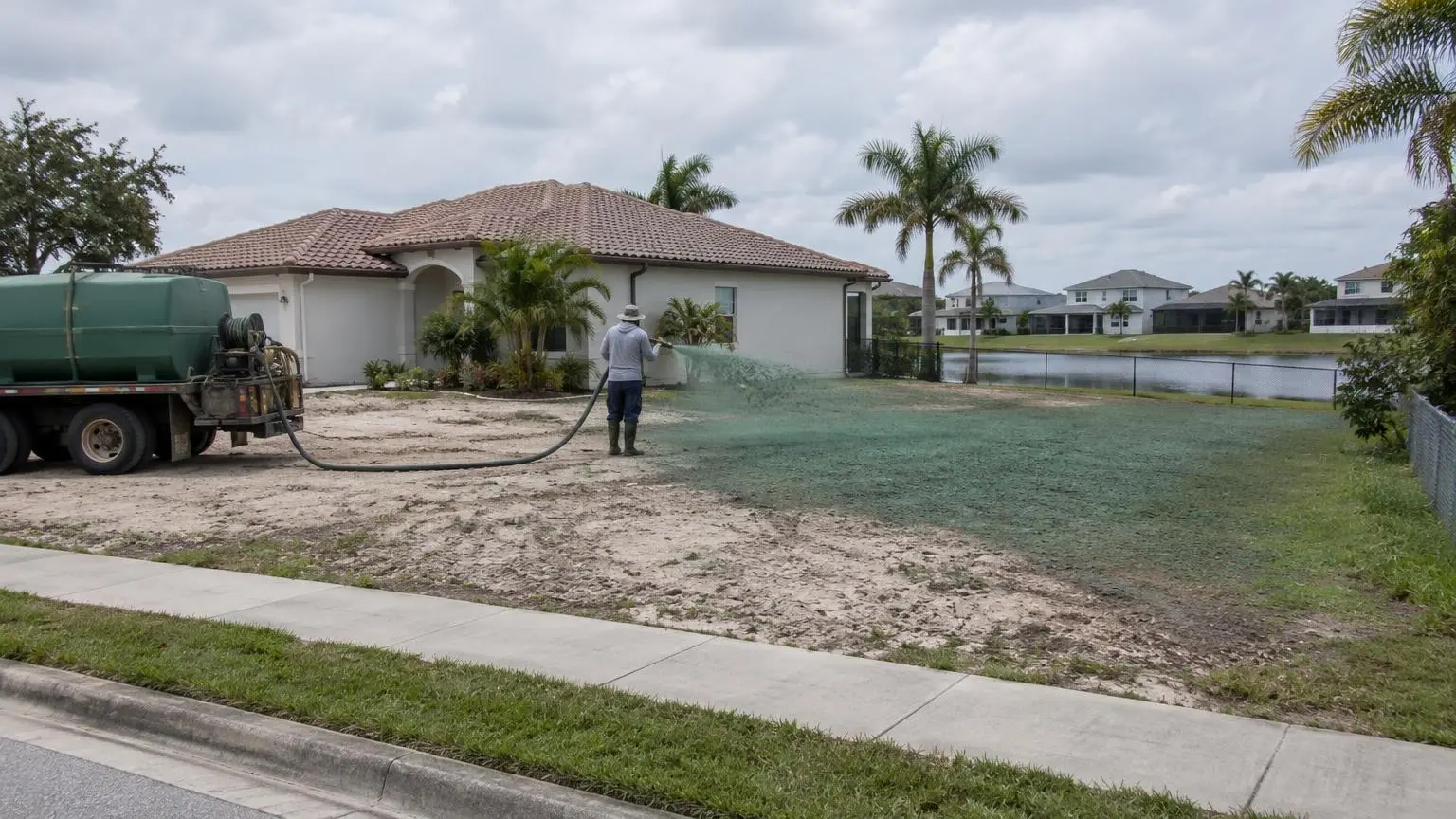
Canal bank and swale erosion control in Miami is about the places a flat region still moves water fast: roadside swales, drainage ditches, pond and lake banks, canal edges and the short slopes around raised pads. Most of the metro averages only a few feet above sea level, but water still runs downhill, and a summer thunderstorm pushes a lot of it through a narrow channel in a short time. Elite Hydroseeding Miami installs the erosion control products that let grass establish in those spots instead of washing out.
Why swales fail here
Miami's rainy season is driven by daily thundershowers in humid air, and June and September each average more than 10 inches of rain at the airport. A freshly graded swale or bank is just loose sand and fill. UF/IFAS advises that steep swales should be sodded or lined with an erosion-resistant material able to handle the flow, and that mounds steeper than 10 percent should be sodded rather than seeded. That guidance shapes most of our recommendations: plain seed on flat ground, blankets or heavier mulch where water concentrates, and sod or armoring where flows are too strong for seed.
Erosion control blankets
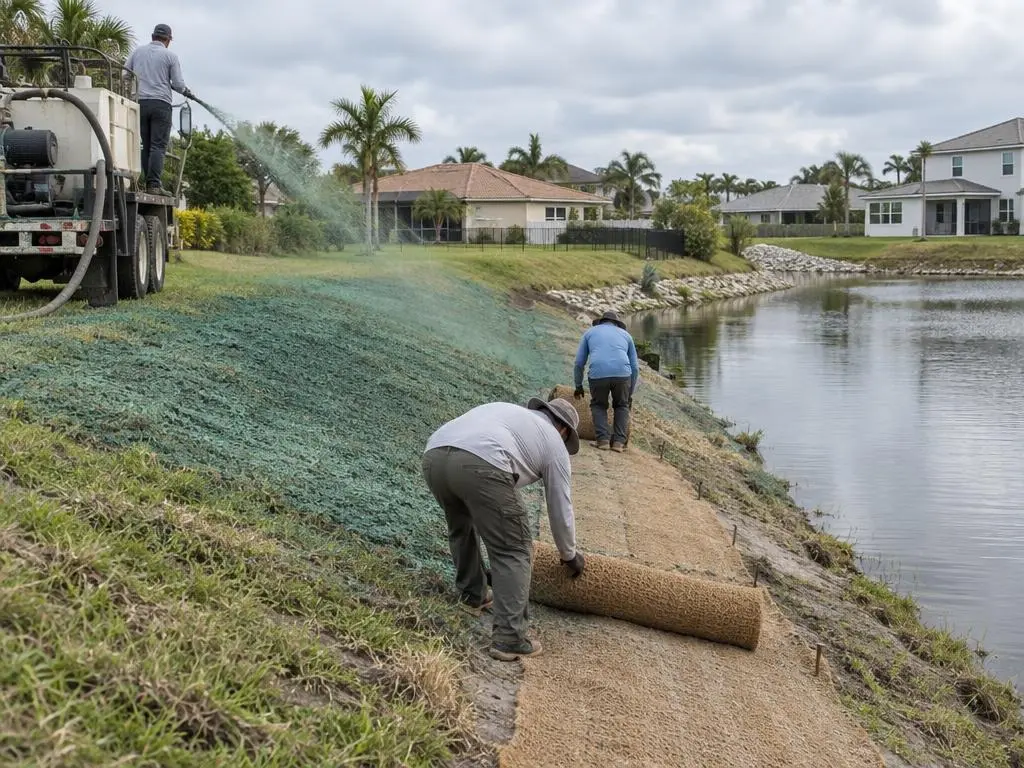
Straw blankets, straw-coconut blends and all-coir blankets are rolled out over seeded soil and stapled down. They hold the seed in place, slow surface water and break down as grass grows through. Straw is fine for gentle swales. Coir lasts longer and suits banks that see repeated flow. On a canal or lake edge, blankets go from the top of the slope down toward the water line, overlapped so water cannot get under them.
Hydromulch and bonded fiber matrix
Hydro mulching uses the same truck as hydroseeding, with heavier wood fiber and tackifier rates to form a protective layer on bare slopes. A bonded fiber matrix is a heavier product designed to stick to steeper ground and resist rain impact. Both are sprayed, so they reach banks and odd shapes where rolling out a blanket is slow. We pick between them by slope, flow and how quickly the area has to be stable.
Slope stabilization around pads and lots
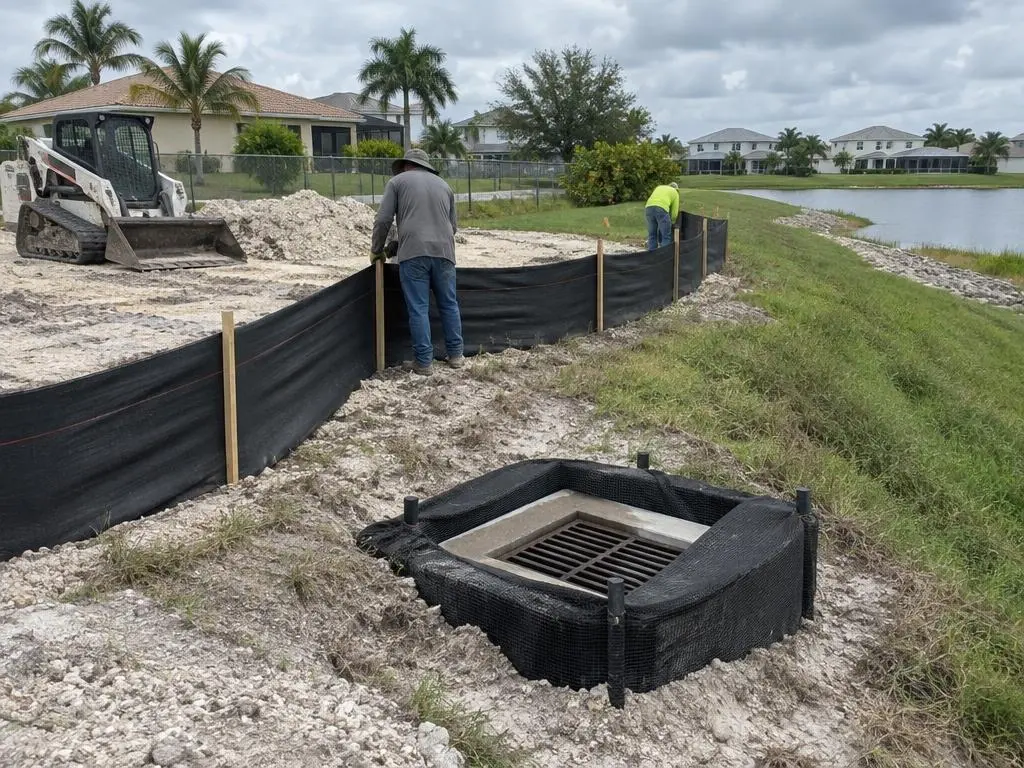
New homes and commercial buildings here are often set on raised fill, leaving short, steep edges around the pad. UF/IFAS recommends grading residential sites at 1 to 2 percent away from the house; where a lot cannot meet that without a steeper edge, those edges are where erosion starts. We seed the edges and protect them with blankets or bonded fiber, or recommend sod and landscape plantings where the grade is too steep to mow safely. UF/IFAS notes mowing slopes steeper than 3:1 is not recommended.
Timing with the storm season
The best time to protect a slope is before the rains begin, which in Miami usually means getting work done by late May. Hurricane season runs through November and is most active from mid-August through September. If a site will be bare during those months, it should be covered. We schedule erosion control work ahead of the wet season wherever we can, and return after big storms to repair washouts.
Who we do this for
Homeowners with a washing swale or a lake-edge yard, HOAs maintaining pond banks, builders with raised pads and ditches, and property managers with eroding drainage areas. On permitted projects we install the products named in the plan.
Erosion Control Options
Matched to the slope and how hard water hits it.
Straw erosion control blankets
Short-term cover for gentle swales and seeded slopes.
Straw-coir and coir blankets
Longer-lasting cover for banks with repeated flow.
Hydromulch
Heavy wood-fiber slurry with tackifier for bare slopes and pads.
Bonded fiber matrix
A sprayed layer that holds on steeper ground and resists rain impact.
Swale and ditch lining
Seed plus blankets fitted to the channel shape.
Post-storm repair
Reshaping, reseeding and new blankets after washouts.
What Erosion Control Products Cost
| Product | Range (source) |
|---|---|
| Sprayed wood-fiber hydromulch, per 1,000 sq ft (state DOT bid prices, 2025 edition) | $98 |
| Straw and coconut blend blanket, each 1,000 sq ft laid (same list) | $468 |
| All-coir blanket, each 1,000 sq ft laid (same list) | $532 |
| Added cost on steep slopes, per sq ft (HomeGuide) | $0.05 to $0.10 |
The rate schedule is state DOT bid prices, 2025 edition, not a Miami price. No current published price was found for bonded fiber matrix, so it is set once we measure the slope. For a feel of the market only; your price comes in a written quote.
Our Erosion Control Steps
1. Look at the flow
We see where water enters, how fast it moves and where it leaves.
2. Reshape
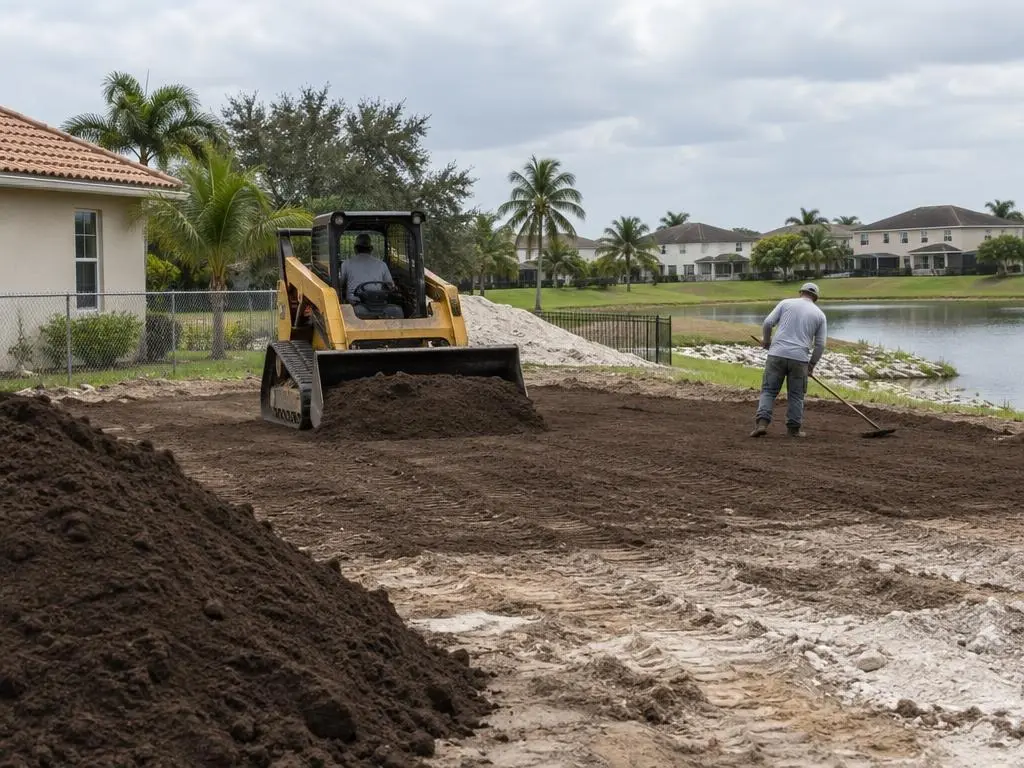
Fill gullies, smooth the channel and set a stable grade.
3. Seed
Seed sprayed or spread on the prepared soil.
4. Cover
Blankets stapled down, or hydromulch or BFM sprayed over the seed.
5. Check after rain
We inspect after the first heavy storms and repair weak spots.
Why Choose Us for Canal Bank & Swale Erosion Control
Product matched to flow
We do not put plain seed where a blanket or sod is needed.
One crew for seed and cover
Seeding and blankets go in together, so nothing sits bare.
Pre-season scheduling
We aim to finish slopes before the rains set in.
Canal Bank & Swale Erosion Control Questions
Why does my roadside swale keep washing out?
Usually the grass never fully rooted before heavy rain, or the channel carries more water than seed alone can resist. Reshaping, then seed with a blanket, normally fixes it.
Blanket or bonded fiber matrix: which one?
Blankets are best in channels and on banks where water runs over the surface. Sprayed products are faster on large or irregular slopes. We recommend one based on the slope and flow.
Can you work on a canal or lake bank behind my house?
We can stabilize the upland slope down toward the water line. Work in or right at the water may need approval from the agency that manages the canal, so check first.
Do blankets need to be removed?
As the grass grows up through them, straw and coir blankets slowly rot away. Some types carry netting; we will tell you which one goes on your site.
Canal Bank & Swale Erosion Control Service Areas
- Hydroseeding in Miami, FL
- Hydroseeding in Homestead, FL
- Hydroseeding in Florida City, FL
- Hydroseeding in Redland, FL
- Hydroseeding in Cutler Bay, FL
- Hydroseeding in Palmetto Bay, FL
- Hydroseeding in Pinecrest, FL
- Hydroseeding in Kendall, FL
- Hydroseeding in Country Walk, FL
- Hydroseeding in South Miami, FL
- Hydroseeding in Coral Gables, FL
- Hydroseeding in Doral, FL
- Hydroseeding in Medley, FL
- Hydroseeding in Hialeah, FL
- Hydroseeding in Miami Springs, FL
- Hydroseeding in Miami Lakes, FL
- Hydroseeding in Pembroke Pines, FL
- Hydroseeding in Weston, FL
- Hydroseeding in Davie, FL
- Hydroseeding in Southwest Ranches, FL
- Hydroseeding in Cooper City, FL
- Hydroseeding in Hollywood, FL
Get a Canal Bank & Swale Erosion Control Estimate
Describe the slope or swale and we will come look at it.